

Mulder Design
Studio Mulder Design Delivers Naval Architecture for 50-Metre Superyacht ATLANTIDE
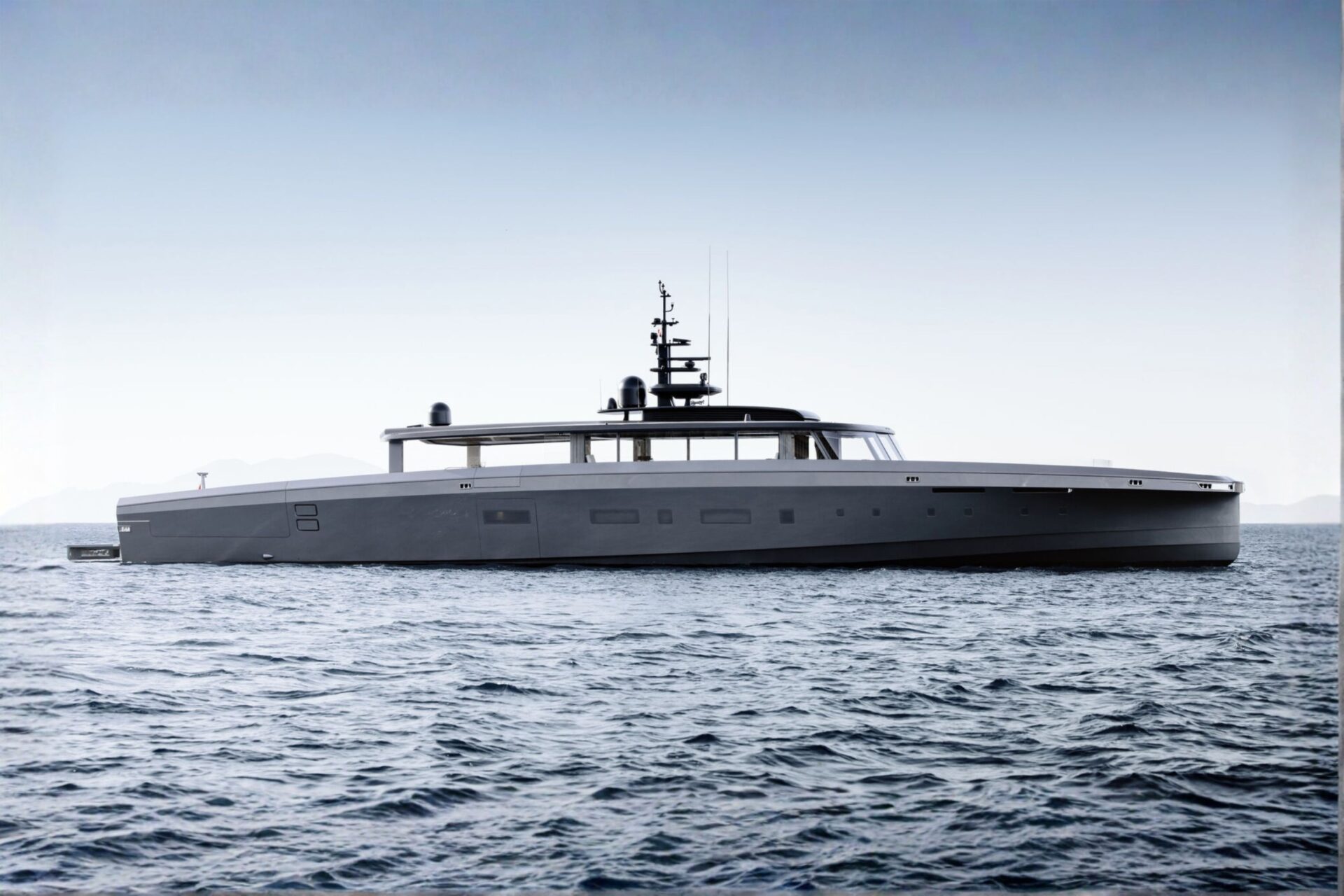
Studio Mulder Design is pleased to announce the delivery of the 50-metre superyacht ATLANTIDE, for which the studio was responsible for the naval architecture. Built by Alia Yachts, with exterior design by Philippe Briand of Vitruvius Yacht Design and interior design by Liaigre, ATLANTIDE was launched on 27 October 2025 and officially delivered to her owner on 17 July 2026.

From design vision to engineered platform
ATLANTIDE combines ambitious performance targets with a distinctive exterior and a technically demanding lightweight construction. Studio Mulder Design’s role was to translate Philippe Briand’s vision of a sleek, low-profile silhouette, generous beam and expansive deck spaces into a fully engineered platform, balancing hydrodynamic efficiency, structural integrity, weight control and onboard comfort.
The combination of relatively high speed, triple-waterjet propulsion and shallow draft led to a comparatively wide hull form. Computational Fluid Dynamics (CFD) was applied from an early stage to optimise the hull and minimise resistance, with specific attention to the integration of underwater appendages such as the bow thruster and exhaust arrangements.
The integration of the three waterjets was a central element of the hull development. An efficient and undisturbed water supply to the jet inlets is essential for propulsion efficiency, which made the design of the aft body and the positioning of the propulsion system an integral part of the naval architecture from the outset.

Form and function
The yacht’s aircraft-carrier-inspired bow is one of her most recognisable features. Originating as an exterior design statement, the geometry also serves a functional purpose: it deflects waves and spray away from the yacht and provides the required space for the bow anchor arrangements.

Structural engineering
Large hull and superstructure openings, expansive interior volumes and moving elements such as the pop-up door required careful structural analysis. Finite Element Method (FEM) calculations were used to optimise critical areas, maintaining stiffness without adding unnecessary weight.
A notable engineering detail is the connection between the aluminium structure and the carbon-fibre roof. The roof is supported by six aluminium columns that locate into stepped recesses within the composite structure, increasing the bonding surface, distributing loads more effectively and limiting local stresses at the aluminium-to-composite interface.

Integrated collaboration
Throughout the project, the naval architecture and structural engineering were developed in parallel with the exterior and interior design, in close collaboration with Alia Yachts, Philippe Briand and Liaigre. This approach allowed technically demanding features to be incorporated without compromising the original design intent.
ATLANTIDE reflects Studio Mulder Design’s approach to naval architecture: applying hydrodynamics, structural engineering and practical yacht-building experience to create the technical freedom required for ambitious design, performance and innovation.
"*" indicates required fields